

Presentation
Apr 02, 2026
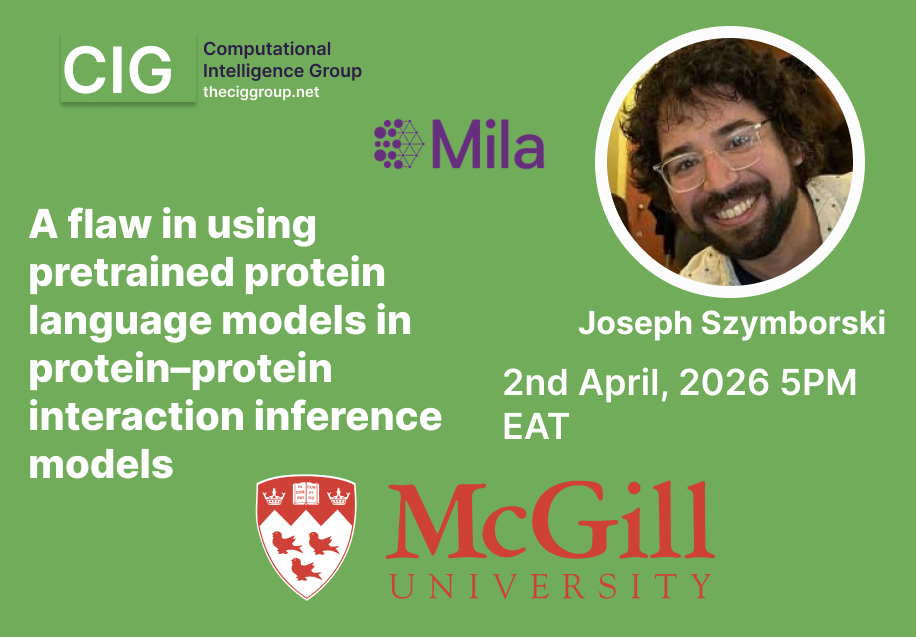
A flaw in using pretrained protein language models in protein–protein interaction inference models
Paper Author
Joseph Szymborski
McGill University
Presented by


Abstract
With the growing pervasiveness of pretrained protein language models (pLMs), pLM-based methods are increasingly being put forward for the protein–protein interaction (PPI) inference task. Here we identify and confirm that existing pretrained pLMs are a source of data leakage for the downstream PPI task. We characterize the extent of the data leakage problem by training and comparing small and efficient pLMs on a dataset that controls for data leakage (strict) with one that does not (non-strict). Although data leakage from pretrained pLMs cause a measurable inflation of testing scores, we find that this does not necessarily extend to other, non-paired biological tasks such as protein keyword annotation. Further, we find no connection between the context lengths of pLMs and the performance of pLM-based PPI inference methods on proteins with sequence lengths that surpass it. Furthermore, we show that pLM-based and non-pLM-based models fail to generalize in tasks such as prediction of the human-SARS-CoV-2 PPIs or the effect of point mutations on binding affinities. This study demonstrates the importance of extending existing protocols for the evaluation of pLM-based models applied to paired biological datasets and identifies areas of weakness of current pLM models.
Research Paper
Previous Talks
48 talks
PathInHydro, a Set of Machine Learning Models to Identify Unbinding Pathways of Gas Molecules in [Ni
Oct 04, 2024
Ariane Nunes-Alves

Self-supervised graph neural networks for polymer property prediction
Feb 20, 2025
Jana M. Weber

Learning-Order Autoregressive Models with Application to Molecular Graph Generation
Aug 07, 2025
Michalis K. Titsias